Why AI-era teams still need both designers and engineers
Whether a feature is handled by a single person or a team with clearly divided roles, its delivery consists of two distinct phases, which always follow a strict sequence:
- What to build?
- How to build it?
The approach in both cases is the same:
- List possible options
- Choose the best one
The difference is what kind of decision you're making:
- In the first phase, decisions focus on appearance and functionality.
- In the second phase, decisions focus on the most effective implementation.
The primary reason designers and engineers will continue to be separate roles is that answering these fundamental questions requires entirely different skill sets:
- Designers excel at rapidly generating multiple viable options.
- Engineers excel at executing the chosen option with precision and technical quality.
An analogy from industrial design: Designers use flexible clay to quickly shape ideas, whereas engineers use metal to turn these concepts into reality.
Even when designers use code as a design tool, the way they use it looks nothing like an engineer's workflow. Designers want the simplest syntax to express ideas visually. Engineers, on the other hand, have to worry about security, reliability, and maintainability.
Let's consider two hypothetical teams over multiple development cycles:
Team A: Two dual-skilled members (Design + Engineering) Handles two tasks simultaneously but requires two cycles per task: determining "What" then "How" to build.
Team B: One dedicated designer and one dedicated engineer The designer continuously moves forward with new tasks while the engineer implements previous tasks, enabling parallel workflows.
Over time, Team A's advantage fades.
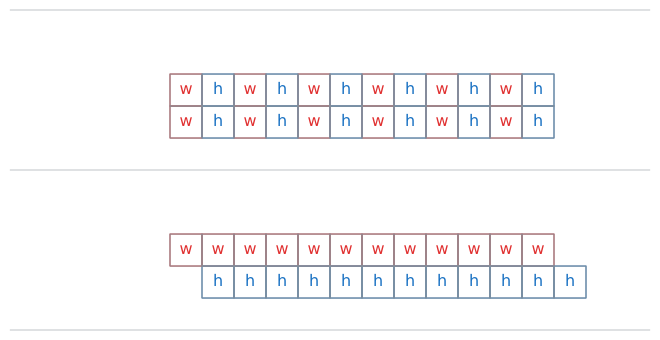
You might argue Team A is more versatile, but here's the critical question: Will someone with both skills accept the same pay as a specialist? Definitely not. Considering salary expectations, Team A quickly becomes significantly more expensive despite only slight efficiency gains.
Even factoring communication overhead, teams with dedicated roles consistently prove more cost-effective by approximately 30–40%.
If you disagree, think about how hard it is to context-switch between tasks in your own work. Now imagine jumping between the mindsets of design and engineering.
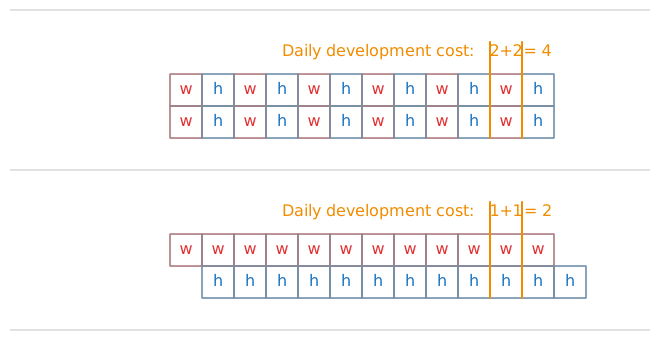
In practice, dual-skilled teams might work in specialized situations — but these are exceptions, and they won't reshape the overall job market. Designers, rest assured: your role isn't going anywhere.
However, AI will certainly transform your workflow significantly.